Bottom line: No, AirTags do not need a Wi-Fi connection of their own to work. They do not join Wi-Fi networks like a phone, tablet, or laptop. Instead, AirTag uses Bluetooth for nearby finding and Apple’s Find My network to help relay its location through nearby Apple devices.

That distinction matters because many people assume a tracker must connect directly to Wi-Fi or cellular data to be useful. AirTag works differently. It depends on nearby devices in Apple’s ecosystem rather than on its own internet connection.
How AirTag works without Wi-Fi
AirTag does not have built-in Wi-Fi or cellular connectivity. Instead, it broadcasts a secure Bluetooth signal that nearby Apple devices in the Find My network can detect.
When one of those nearby devices detects the AirTag, it can securely relay the item’s location to iCloud so the owner can see it in the Find My app. This is why AirTag can still help you find a lost item even though the AirTag itself never joins your home Wi-Fi, hotel Wi-Fi, or a mobile data network.
In practical terms, AirTag is less like a self-connected GPS tracker and more like a small finder that borrows the reach of Apple’s wider network.
What happens in places with no Wi-Fi nearby?
AirTag can still work even if there is no Wi-Fi network around, because the key requirement is not Wi-Fi itself. The bigger question is whether there are nearby Apple devices that can detect the AirTag and relay its location through the Find My network.
That is why AirTag tends to feel stronger in busy places such as cities, airports, train stations, hotels, and shopping areas. In those environments, there are simply more nearby Apple devices that might detect the AirTag.
In remote or lightly populated places, updates can be much slower because there are fewer nearby devices to pass along the AirTag’s location. So the answer is still “yes, AirTag can work without Wi-Fi,” but the real-world experience depends heavily on where the item is and how many Apple devices pass nearby.

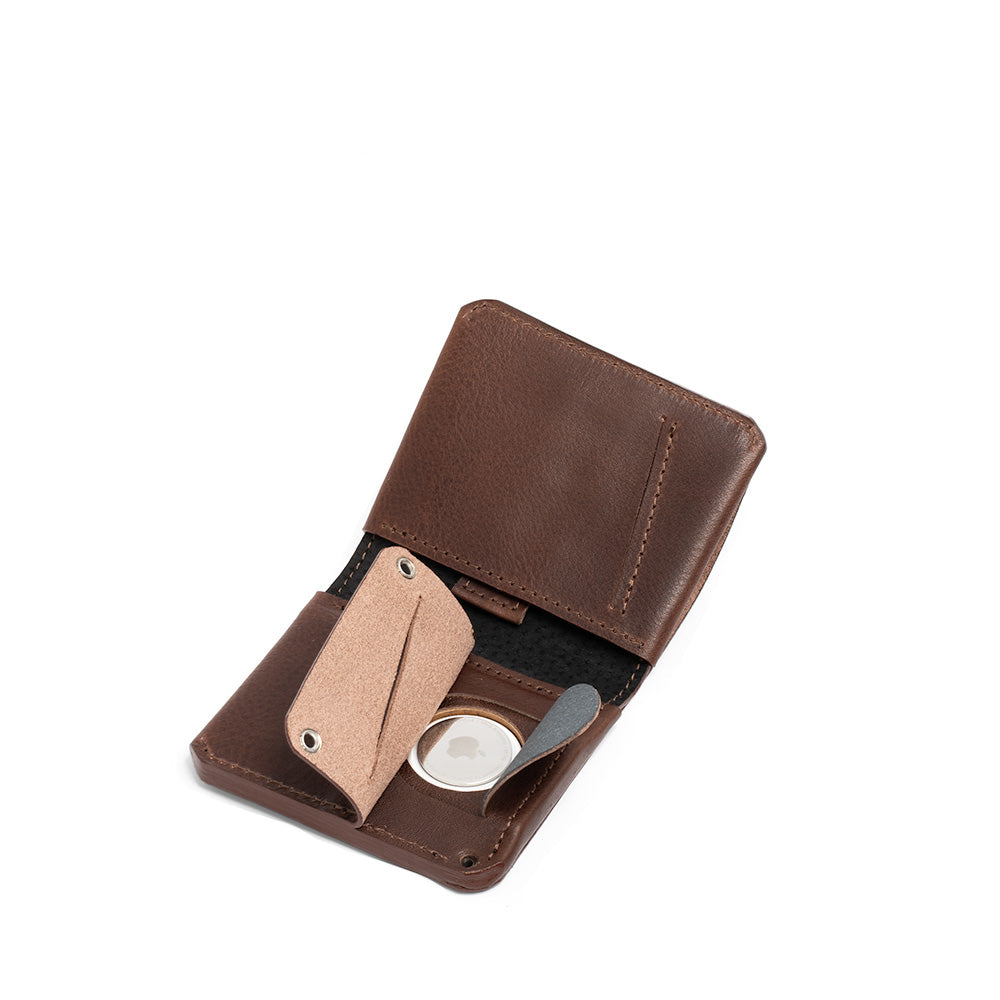
Geometric Goods' AirTag Wallets are designed to make your experience more stress-free thanks to a secret AirTag pocket.
What the current AirTag changed
The biggest technical update to the older version of this article is simple: Apple’s current AirTag page now lists an Apple-designed, second-generation Ultra Wideband chip with expanded Precision Finding connectivity.
Apple also says the newer AirTag brings a longer Bluetooth range, Precision Finding from up to 50 percent farther away, and a louder speaker. That improves the nearby-finding experience, but it does not change the core answer to this article. AirTag still does not become a Wi-Fi tracker or a cellular tracker.
The technologies behind AirTag connectivity
Bluetooth
Bluetooth is the foundation of AirTag’s connectivity. It is what lets nearby Apple devices detect the AirTag and what makes local item finding possible.
Ultra Wideband and Precision Finding
When you are near the item and using a supported iPhone, Precision Finding can help guide you with direction and distance information. This is the part of the experience that feels more precise than a normal Bluetooth tracker.
NFC in Lost Mode
AirTag also includes NFC support for lost-item recovery. If someone finds your AirTag, they can tap it with an NFC-capable smartphone and view the information Apple makes available for returning the item.
Privacy and security features
Apple’s Find My network is designed to be encrypted and anonymous, and Apple also includes protections against unwanted tracking. AirTag and other Find My accessories are designed to alert people if an unknown tracker appears to be moving with them over time.
That privacy design is part of why AirTag works the way it does. It is meant to help you find lost belongings, not function as an unrestricted people-tracking tool.
Bottom line
If you were looking for the simplest possible answer, here it is: AirTags do not need Wi-Fi.
They work by combining Bluetooth with Apple’s Find My network, which means nearby Apple devices can help relay location information securely. That makes AirTag very useful even without its own internet connection, although results are naturally better in places where more Apple devices are nearby.
The current AirTag has improved nearby-finding hardware, but the basic idea is still the same: no direct Wi-Fi, no direct cellular, and still very capable for finding everyday items.